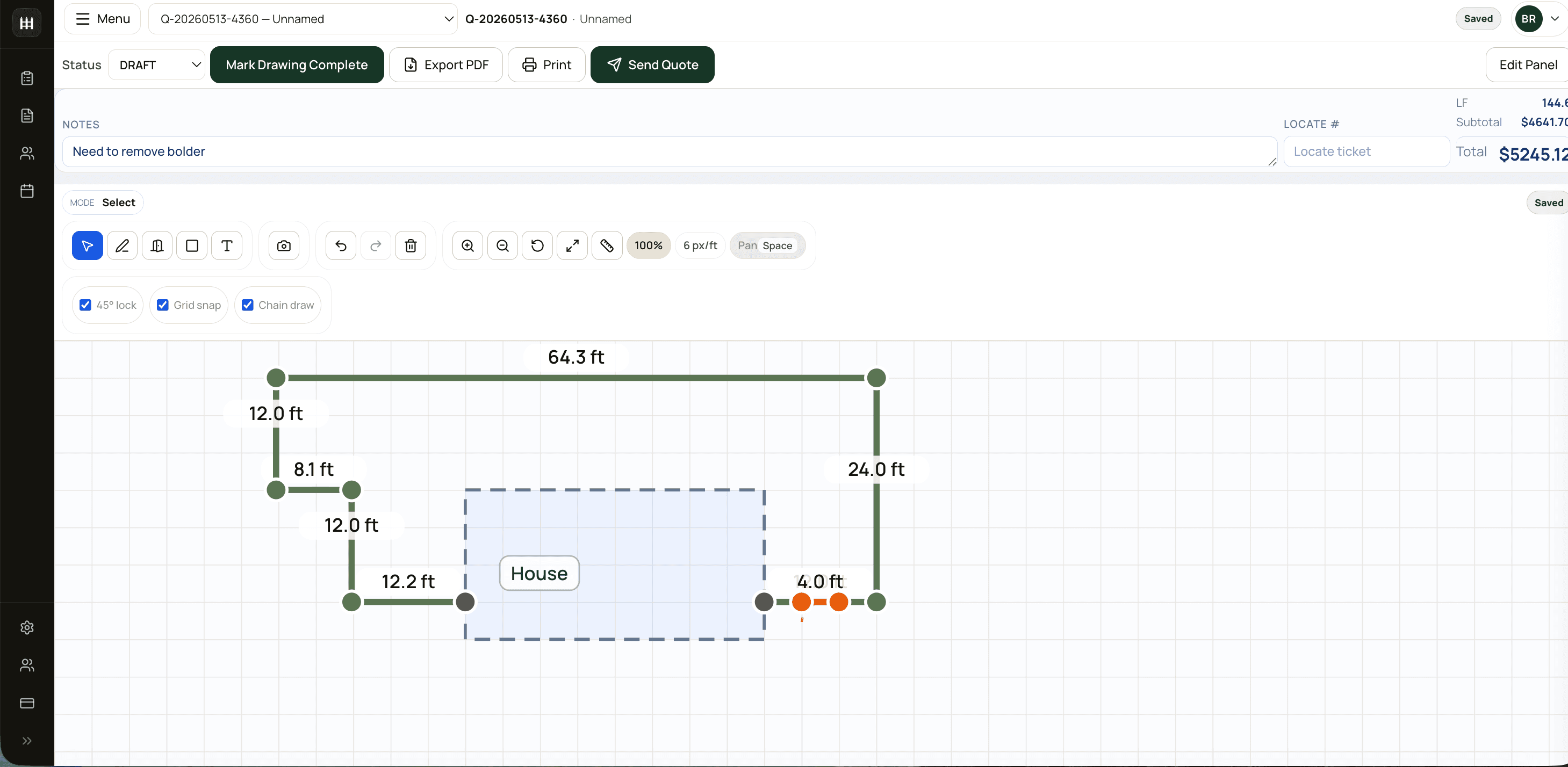
Chain Link Fence Estimator
Chain link is the most math-heavy fence vertical. A single 100-foot run produces a parts list that most estimators count by hand: line posts every 10 feet, terminal posts at corners and ends, top rail by the length, tension wire and brace bands, fabric by linear foot, gates with their own post + hardware assemblies. Miss one and the crew is back at the supplier mid-install.
FenceTracer's chain link fence estimator computes all of it from the drawing. Snap a layout, the takeoff engine returns the right post counts, the right fabric run, the right gate hardware, and a priced quote. The catalogue is slot-mapped specifically for chain link, so the same logic runs every quote without an estimator counting parts.
1 post / 10 LF
Line post math, automatic30s
Drawing to priced quoteStarter
Pricing included$59
CAD/mo Solo · Company $180 flat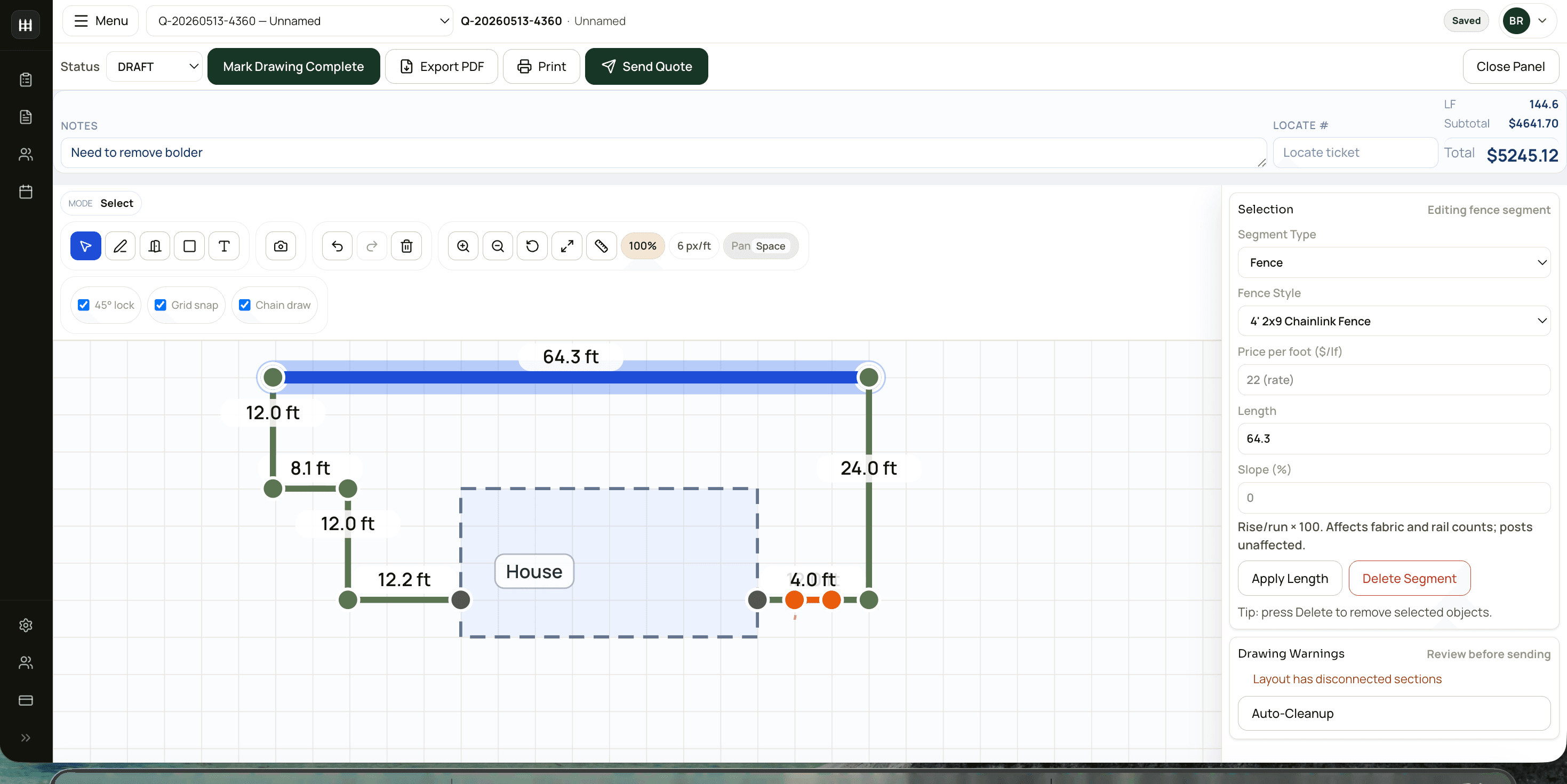
Why chain link estimating is uniquely error-prone
Chain link runs on assemblies, not single SKUs. Every quote needs:
- Line posts — typically 1 per 10 LF, but spacing varies by height (4', 5', 6', 8', 10', 12') and post weight class.
- Terminal posts — at every corner, end, and gate opening; usually a heavier gauge than line posts.
- Top rail — by the linear foot, with rail-end fittings at every terminal post.
- Fabric — by the linear foot, by height, by gauge (9 gauge, 11 gauge, 11.5 gauge, 6 gauge for commercial), and by coating (galvanized, vinyl-coated black/green/brown).
- Tension wire and bands — at the bottom (and sometimes top) of the fabric run.
- Brace bands, tension bars, rail ends, post caps, tie wire — small parts that add up.
- Gate assemblies — walk gates and double-drive gates each have their own post + frame + hardware (hinges, latch, drop rod, gate fork).
- Labour — by linear foot, with extras for tie-ins, slopes, and removal.
An estimator counting these by hand on a 300-foot commercial run will spend 20–40 minutes and still produce a parts list with small errors. The chain link fence estimator inside FenceTracer runs the same logic in 30 seconds and stays consistent across every estimator on the team.
How FenceTracer's chain link estimator works
- Draw the run. Snap corners on the canvas. Sloped lengths and angles compute automatically.
- Pick chain link style. Height, gauge, coating, top rail or not, slats or not. Each combination maps to a chain link assembly in the catalogue.
- Place gates. Walk gates (typically 3' or 4') and double gates (typically 10', 12', or 16') drop with one click and pull their own post + hardware assemblies.
- Quote regenerates live. Linear feet, line post count, terminal post count, fabric run, top rail length, gate hardware, labour — all priced from your catalogue with the right margin.
- Send the PDF. Branded, itemized, tax-ready.
Multi-segment runs handle real-world scenarios: a chain link backyard with a walk gate at the side and a double gate at the back, with a slope on the back run, finished in vinyl-coated black 4' fabric and galvanized top rail. The estimator clicks. The quote builds.
Chain link assemblies FenceTracer ships with
Residential chain link
- 4' / 5' / 6' galvanized chain link with top rail
- 4' / 5' / 6' vinyl-coated chain link (black, green, brown)
- 6' galvanized with privacy slats
- Walk gate (3' / 4') and double drive gate (10' / 12') in matching height
Commercial chain link
- 6' / 8' / 10' / 12' galvanized chain link with top rail and (optional) bottom tension wire
- Heavier gauge fabric (9 gauge or 6 gauge)
- Three-strand barbed wire arms (45° or vertical)
- Privacy slats or windscreen options
- Cantilever rolling gates and swing double gates
You can edit, duplicate, or add to any of these. They're starting points, not constraints.
How a chain link fence estimator compares to manual estimating
| Feature | FenceTracer | Spreadsheet + manual count |
|---|---|---|
| Time per chain link quote | 30–60 seconds | 20–40 minutes |
| Line post count | Automatic per LF | Counted by hand on the drawing |
| Terminal post count | Automatic at corners/ends/gates | Counted by hand |
| Top rail length | Computed from drawing | Measured manually |
| Fabric LF | Computed | Measured manually |
| Gate hardware assembly | Auto-attached per gate | Recalled from memory or missed |
| Slope adjustment | True length, automatic | Often missed or guessed |
| Consistency between estimators | Same logic every quote | Varies per estimator |
| Revision time | Seconds | Re-do the whole count |
Common chain link estimating mistakes FenceTracer prevents
- Missing terminal posts at every gate. A double drive gate needs 2 terminal posts (one each side); estimators forget the second one.
- Wrong fabric height for the post height. 6' posts with 5' fabric leaves a top-rail gap; FenceTracer's catalogue ties post height to fabric height.
- Slope under-measurement. A run that drops 4' over 40 LF is 40.2 LF on the ground but more on the drawing — FenceTracer computes the slope-corrected length automatically.
- Forgetting tension wire at the bottom. Required on most commercial installs; FenceTracer's commercial chain link assemblies include it by default.
- Wrong gate hardware kit. Walk gates and double gates need different hinge counts and latch types; FenceTracer attaches the right kit per gate type.
- Tax errors on cross-border or cross-region jobs. US shops need ZIP-backed sales tax checks or manual overrides; Canadian shops need the right province-aware tax label and rate. FenceTracer keeps tax tied to the install address before send.
Who FenceTracer's chain link estimator is for
- Chain link specialists who do 80%+ chain link work — the per-LF math is the bottleneck and FenceTracer eliminates it.
- Mixed-vertical shops that do chain link, wood, and ornamental — FenceTracer handles all three and a single quote can combine styles.
- Commercial fence contractors with heavier-gauge fabric, barbed wire, and rolling gates — the commercial chain link assemblies are pre-built.
- US and Canadian fence contractors dealing with local tax, quote PDFs, and crew handoff from the same chain link drawing.
Pricing
From $59 CAD/month on Solo. Company is $180 CAD/month, flat — unlimited chain link quotes and users. US workspaces quote in USD; Canadian workspaces quote in CAD. 30-day trial, no credit card, starter pricing included.
FenceTracer
Estimate chain link in 30 seconds
Snap a chain link layout, get line posts, fabric, top rail, gates, and labour computed automatically. Starter pricing is included, and supplier imports can wait. 30-day trial, no credit card.FAQ
Frequently asked questions
How accurate is FenceTracer's chain link takeoff?
It computes from the drawing using the same per-LF math an experienced estimator uses — 1 line post per 10 LF, terminal posts at every corner/end/gate, fabric LF equal to the slope-corrected run length. Most shops find the takeoffs match (or exceed) their manual counts after a week of use.
Can I adjust the line post spacing rule?
Yes. Default is 1 post per 10 LF, but you can override per fence style (e.g., 1 per 8 LF for high-wind areas). The override applies to that style on every quote going forward.
Does FenceTracer handle commercial chain link with barbed wire and rolling gates?
Yes. Commercial chain link assemblies include 8'–12' heights, three-strand barbed wire arms (45° or vertical), 6-gauge or 9-gauge fabric, and cantilever rolling gates. Add or edit any assembly to match your shop's standard build.
How does FenceTracer estimate sloped chain link runs?
The geometry engine computes the true (slope-corrected) length from elevation changes you set on the drawing. The fabric and rail order against the slope-corrected LF, not the horizontal projection — so you don't come up short on a steep run.
Can I import my supplier's chain link pricing?
Yes. CSV import is built in. Master Halco, Wholesale Fence Supply, Atlas — map your SKUs to FenceTracer's chain link slots once and every quote prices against your current cost.
Does FenceTracer support privacy slats and windscreen?
Yes. Both as catalogue items priced per LF. Privacy slats apply to a chain link segment; windscreen is a separate add-on with its own labour. Both show on the quote PDF as itemized scope.
What about chain link removal and disposal?
Add a removal segment to the drawing (same canvas tool); FenceTracer applies a removal labour rate by LF and a disposal flat fee. Both show on the quote as separate line items.
Related reading
- Fence estimating software — overview of the drawing-driven workflow
- Wood fence estimator — sibling fence-style estimator
- Fence quote software — quote PDF + proposal workflow
- Fence cost calculator (Canada) — ballpark pricing reference
- The Complete Catalog and Pricing Guide
- FenceTracer vs JobNimbus