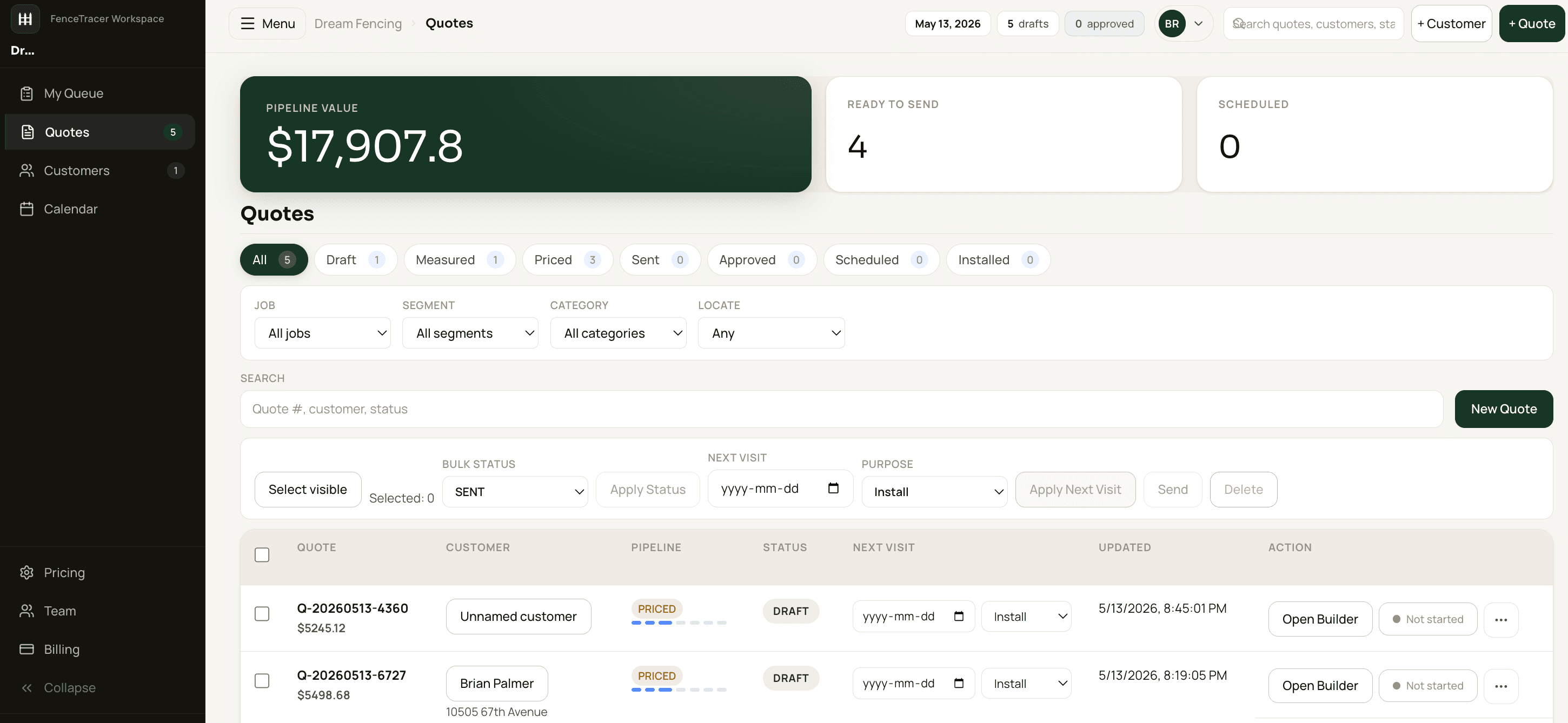
Spreadsheets feel free because there's no monthly bill. There is, though. It's just paid in hours, lost quotes, mispriced jobs, and the occasional tax mistake that costs you a relationship with a customer. This article puts a real dollar figure on each one, then runs the comparison against $180 CAD/month for FenceTracer.
If you're a fence contractor still quoting in Excel, Google Sheets, or a Word template — this is for you. (If you just need a better document for now, start with our fence quote template.)
The four hidden costs of spreadsheet quoting
1. Time per quote
Self-reported time-per-quote for spreadsheet workflows lands in the 30–60 minute range — site measurement → manual line items → copy/paste from last quote → tax math → cleanup → email. For most shops it's closer to the top of that range than the bottom.
30 minutes per quote × 20 quotes/month   = 10 hours/month
60 minutes per quote × 20 quotes/month   = 20 hours/month
At a $50/hr fully-loaded estimator cost, that's $500–$1,000/month of time, just on the quoting itself. The software cost ($180) is dwarfed by it.
2. Math errors
Every contractor has a story: forgot to add the gate, used last year's post price, copied the wrong tax row, the spreadsheet auto-converted a SKU to a date. The errors that go under are paid by you. The errors that go over — you find out when the customer calls a competitor.
Even a 2–3% error rate on quoted jobs is meaningful. On $50,000/month of quoted work, a 2% error rate is $1,000 of margin you're either eating or leaving on the table. Drawing-driven fence takeoff software removes most of these by counting posts, rails, and gates from the layout instead of from memory.
3. Lost quotes
A spreadsheet quote that takes 45 minutes is a quote you sometimes don't send. Hot lead comes in Tuesday, you're on a job until Friday, by Monday it's been a week and the customer signed with someone faster.
Industry data is fuzzy, but the pattern is consistent: contractors who quote within 24 hours close meaningfully more often than contractors who quote within 7 days. One extra $4,000 fence per quarter from faster quoting is ~$1,300/month in margin that doesn't show up in your spreadsheet because the spreadsheet quote was never sent.
4. Tax mistakes
If you operate in Canada and especially across HST/GST/QST boundaries, place-of-supply tax rules are not optional and not obvious. ON installs get 13% HST, QC installs get 5% GST + 9.975% QST, an install for an Indigenous customer on reserve might be exempt. Get it wrong and either you eat the difference or you have an awkward conversation with the customer. The HST, GST and QST guide for fence contractors walks through each case.
In a spreadsheet, you remember to apply the right rate. In FenceTracer, you enter the install address and the system knows.
Run your real numbers
The calculator below is pre-loaded with the spreadsheet preset (current software cost = $0). Change the crew size, quotes per month, and your real time-per-quote — see what your actual cost is today.
ROI calculator
Your savings with FenceTracerAll figures in CAD. Numbers update as you type, adjust to match your shop.If the calculator shows you saving anything north of $300/month, the $59–$180/month FenceTracer cost is paying for itself roughly three times over, just on the time you get back. Everything else (fewer errors, faster quotes, automatic tax) is upside. To compare against a paid tool instead of a spreadsheet, use the standalone fence software ROI calculator.
What changes when you switch
| Feature | FenceTracer | Spreadsheet |
|---|---|---|
| Software cost | Company $180 CAD/month flat; Solo $59/mo | $0/month |
| Time per quote | ~10 minutes (draw, price, send) | 30–60 minutes |
| Math errors | Catalogue-priced — no manual line totals | Manual cell references, easy to break |
| Tax handling | Auto-applied from install address | Manual per quote |
| Quote PDF | Branded, customer-ready, one click | Save-as-PDF, hope formatting holds |
| Drawing / takeoff | Built-in canvas with chain-link engine | Pen-and-paper or napkin sketch |
| Pipeline view | Open / sent / accepted dashboard | Separate file or your memory |
| Multi-user | Unlimited users included | Email the file around, hope nobody overwrites |
| Audit trail | Every quote version stored | Whatever's in `final-v3-FINAL.xlsx` |
The honest case for staying on spreadsheets
We're not going to pretend there's no scenario where a spreadsheet is fine. There are real ones:
- You quote fewer than 3 jobs a month. The time savings may not clear even the $59 Solo plan.
- You're a side hustle, not a primary income. If fence is a weekend thing, the math is different.
- You've built a serious spreadsheet you genuinely like. Some contractors have a 5-year-old workbook with macros that does exactly what they need. Switching costs real time.
For most everyone else, the spreadsheet is paying you less than minimum wage to keep using it.
FenceTracer
Stop quoting jobs the slow way
From $59/month Solo, $180/month Company with unlimited users, 30-day trial, no credit card. If the math doesn't work for your shop, you'll know inside the first month.FAQ
Frequently asked questions
What's actually wrong with quoting in Excel?
Nothing technically — Excel quotes work. The problems are operational: it's slow per quote, error-prone on math and tax, hard to keep pricing current across multiple files, and the PDFs look like spreadsheets instead of contracts. Solo shops can absorb that; growing shops can't.
Can I import my spreadsheet pricing into FenceTracer?
Yes — FenceTracer has CSV import for catalogue items. Export your sheet to CSV, map the columns to FenceTracer's item types (post, panel, gate, hardware, labour), and you're running on your real prices in an hour. The Toronto 2025 catalogue is also pre-loaded if you want to start from a known-good baseline.
How long does it take to learn FenceTracer compared to my spreadsheet?
Most contractors send their first real quote within 2 hours. The drawing tool is the only piece with a real learning curve, and it's mostly muscle memory — by the third or fourth quote it's faster than typing line items into a spreadsheet.
What if my spreadsheet has formulas I built myself?
Most custom formulas — markup percentages, regional pricing tiers, gate hardware bundles — map directly to FenceTracer's pricing profile. The handful that don't (one-off rules for a specific customer, weird tax overrides) can usually be replaced with FenceTracer's per-quote overrides without losing the logic.
Does FenceTracer work offline like a spreadsheet?
No — it needs an internet connection, since it syncs across users in real time. For most fence shops this isn't a problem: you're either in the office quoting or on-site sketching, both with cell signal. If you genuinely have offline-only requirements, that's worth flagging during the trial.