How Far Apart Should Fence Posts Be?
Post spacing is the quiet decision that prices half the job. Move it six inches and nothing changes on paper; move it two feet and the post count, concrete, and labour all shift by a third. Here's the spacing that holds up in the field, by fence type, with the exceptions worth charging for.
Spacing by fence type
| Fence type | Standard spacing | When to tighten |
|---|---|---|
| Wood board / picket | 8 ft | 6 ft for 8 ft fences or exposed yards |
| Wood privacy (board-on-board) | 8 ft | 6 ft above 7 ft height, open/windy sites |
| Vinyl | 8 ft (panel width) | Fixed by panel length — plan around it |
| Chain link (residential) | 10 ft | 8 ft for 4 ft fabric or slatted |
| Chain link (commercial) | 10 ft | Per spec; 9 ga fabric runs 10 ft fine |
| Ornamental / aluminum | 6–8 ft | Follow the panel kit |
Why 8 ft for wood
An 8 ft bay is the sweet spot between post cost and rail flex: 2×4 rails span it without sagging when pickets are straight and dry. Three things break that assumption:
- Height. At 8 ft, the fence face catches real wind. Solid privacy at 8 ft on 8 ft spacing leans within a few seasons — drop to 6 ft spacing and add the third rail.
- Exposure. An open yard, ridge, or lakefront sees gusts that suburban backyards never do. Treat exposed sites as one height class tighter.
- Wood quality. Green 2×4 rails flex as they dry. If the yard's stock is wet, tighten spacing or size up to 2×6 rails.
Why 10 ft for chain link
Chain link is tensioned, not nailed — the fabric carries between posts under tension from the terminals, so 10 ft bays are standard and 2⅜ in line posts carry them. Tighten to 8 ft when the fabric is light (4 ft heights flop between bays) or when slats go in, because slats add sail area.
The frost question
Spacing decides how many posts; frost decides how deep. Rule of thumb: one-third of the post in the ground, and the bottom of the hole below the frost line — 36–42 in across southern Canada and the northern US, deeper further north. Below frost line, bell the concrete (a wider pad at the bottom) so heave pushes against the bell instead of lifting the post. See how much concrete per fence post for the bags-per-post math.
Corners and gates bend the spacing, not the rules
- Corners are always posts — spacing stops and restarts there. Count each straight run separately.
- Gates are their own bays. A 4 ft gate between two posts means the adjacent bays get cut down to fit — never stretch a bay to absorb a gate.
- Shared lines with a neighbour's existing posts don't give you free structure; the line still needs your posts on your spacing unless the posts are structurally yours.
What tighter spacing costs
Going 8 ft → 6 ft on a 100 ft run: posts go 14 → 18, concrete 28 → 36 bags, caps 14 → 18, labour +~1 hour. Roughly +$250–$350 in materials and setting per 100 ft at starter prices — the wind-load upgrade. Show it as a line on the quote, not a footnote: it's the one upgrade that protects every other line item.
Run your own numbers in the fence calculator — spacing is an input, so you can flip 6/8/10 ft and watch the post count, concrete, and total move live.
FenceTracer
Spacing rules baked into the takeoff
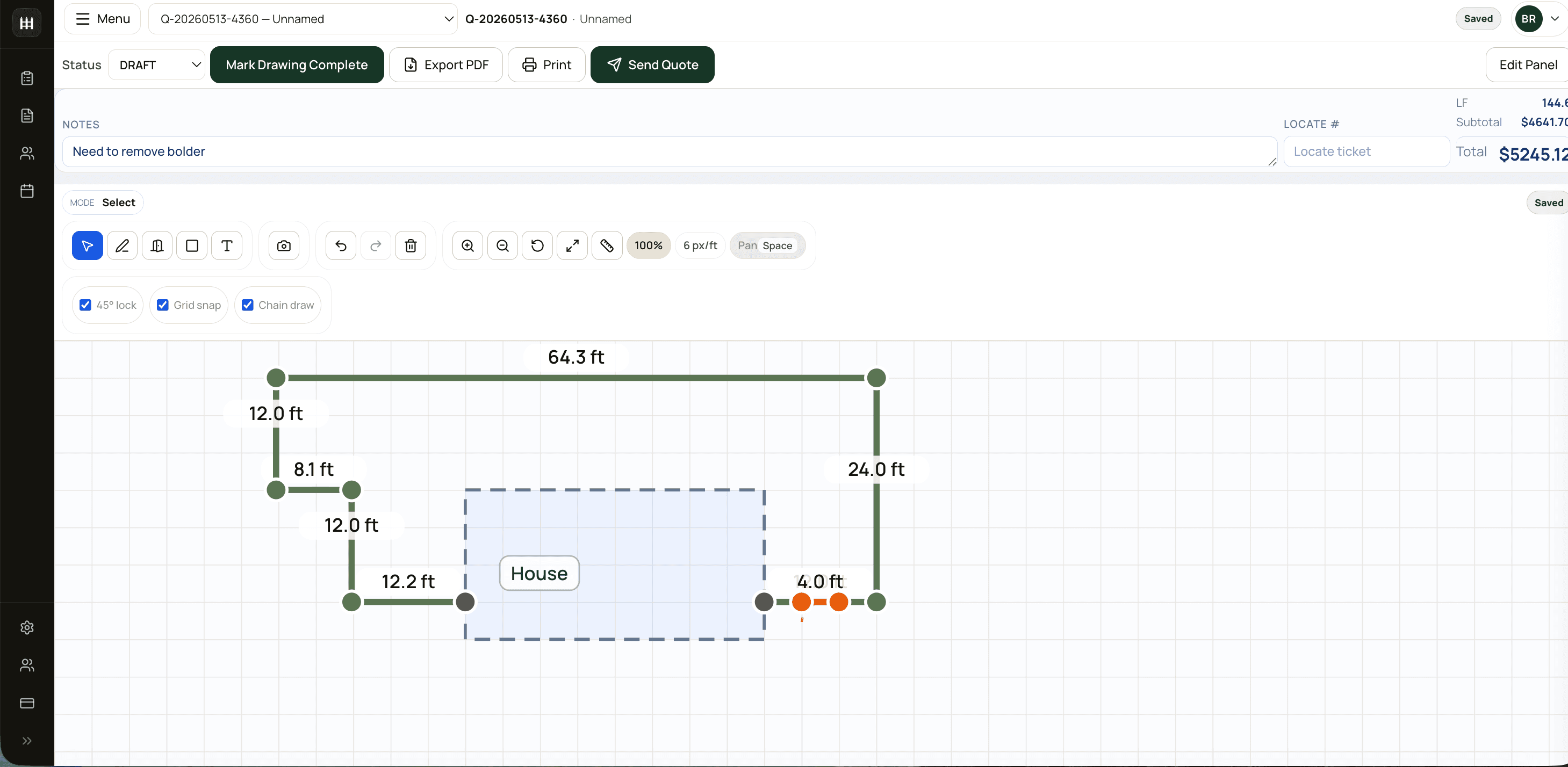
FenceTracer applies post spacing per segment from the drawing — including slope-added footage — so the crew builds what the quote counted. Try it free for 30 days.Frequently asked questions
Is 8 feet too far apart for fence posts?
No — 8 ft is standard for wood and vinyl and fine for 6 ft heights and under with 3 rails. Above 7 ft, on exposed sites, or with solid privacy faces, tighten to 6 ft.
Can I put fence posts 10 feet apart?
For chain link, yes — that's standard. For wood, 10 ft bays need 2×6 rails and dry, straight pickets; most shops avoid it for anything over 5 ft. Vinyl is fixed by panel length (usually 8 ft).
Does post spacing affect fence cost much?
6 ft vs 8 ft spacing adds roughly 35% more posts plus concrete and caps — around $250–$350 per 100 ft in materials. It's the single cheapest upgrade for fence longevity on tall or windy sites.